
Phoenix Metro • Licensed Pros
Closed-Cell Spray Foam Insulation in Phoenix
Maximum R-value per inch plus a built-in moisture barrier — ideal for metal buildings and block walls.
Closed-cell spray foam is the heavy hitter: two-pound-density foam that cures rigid, delivers R-6 to R-7 per inch, blocks moisture at two inches of thickness, and measurably stiffens whatever it's sprayed against. It costs more than open-cell — $1.00–$1.65 per board foot in the 2026 Phoenix market — so we don't spec it everywhere. We spec it where it earns the difference: metal buildings, block walls, flat roofs, and any assembly that has to hold its rating at 160°F deck temperatures.
R-6–7
Per inch installed
Nearly double open-cell's rating — and it holds that number even at the 160°F roof-deck temps a Phoenix summer delivers.
2 lb
Density per cubic foot
Cures rigid, bonds to the substrate, and adds real racking strength to walls and roof decks.
2 in.
Moisture protection threshold
At two inches and beyond, closed-cell functions as a Class II vapor retarder — condensation control built into the insulation.
What Closed-Cell Spray Foam Actually Is
Closed-cell foam is the same two-part polyurethane chemistry as open-cell, but formulated so the cells that form during expansion stay sealed and packed tight — about two pounds per cubic foot, four times the density of open-cell. Each closed cell traps blowing agent instead of air, which is what pushes the rating to R-6–7 per inch, roughly double what any fluffy insulation achieves. Where open-cell cures soft and spongy, closed-cell cures hard enough that you can lean a ladder against it.
That density buys three things at once: the highest R per inch of any common insulation, a built-in moisture barrier at two inches of thickness or more, and genuine structural adhesion. Modern closed-cell formulations use HFO blowing agents — the low-global-warming-potential replacements for the older HFC chemistry — so the environmental math has improved substantially alongside the thermal numbers.
The trade-off is price and expansion. Closed-cell expands only 30–40 times its liquid volume versus roughly 100 for open-cell, so you're paying for more material per inch as well as denser material. At $1.00–$1.65 per board foot it's not the budget play — it's the specification play, for assemblies where nothing else does the job.
Built for Extreme Heat — Why It Holds Up at 160°F
Phoenix roof decks are one of the harshest thermal environments in residential construction. On a 112°F afternoon the unconditioned attic above your head runs 140–160°F, and the deck itself runs hotter. Some insulation materials shed performance as temperatures climb; closed-cell foam holds its R-6-plus rating per inch at full desert deck temperature, which is exactly when you need every unit of resistance you paid for.
That heat stability matters most where the assembly is thin. On a shingle roof with deep rafter bays, open-cell can simply be applied thicker to hit the target. But on a metal roof panel, a flat commercial deck, or a block wall furred out an inch and a half, there is no room for thick — the only way to reach a working R-value in the space available is closed-cell's density. In Zone 2B, where the design fight is 100% about keeping heat out, R per inch in constrained assemblies is closed-cell's home turf.
Where Closed-Cell Earns Its Price
We're an honest shop: for a standard shingle-roof Phoenix attic, open-cell is usually the smarter buy, and we'll tell you so. Closed-cell gets the nod when the assembly has one of four demands — moisture exposure, limited depth, structural load, or metal skin. Around the Valley that translates to a specific and fairly predictable list of projects.
- Metal buildings, shops, and RV garages — condensation control and R-value in one pass on the panel skin
- Block and CMU walls — real R-value in the 1–2 inches a furred-out block wall allows
- Flat and low-slope roof decks — rigid foam base that pairs with elastomeric coatings
- Rim joists and exterior exposures — moisture resistance where the assembly meets outside air
- Older roof decks that flex — the foam bonds and stiffens plank and skip-sheathing decks
- Commercial coolers and conditioned warehouses — maximum R in minimum thickness
Monsoon Moisture and the Raining Ceiling Problem
Phoenix is dry ten months a year, and then monsoon season arrives and dew points jump 20 degrees in an afternoon. Uninsulated metal buildings show the problem dramatically: the roof panel radiates heat to the night sky, drops below the dew point, and by morning condensation is dripping off the purlins onto everything you store — the raining ceiling every shop owner in the Valley has either seen or heard about.
Closed-cell solves it at the physics level. Sprayed directly to the panel, it warms the interior surface above the dew point and simultaneously blocks vapor from reaching the cold metal, because at two inches of thickness the foam itself is a Class II vapor retarder. No liner system, no vapor sheet stapled over batts, no wet fiberglass sagging out of the ceiling three summers from now.
On homes, the same property protects the assemblies that actually see water. Rim areas, parapets, and low-slope sections take wind-driven monsoon rain differently than a steep shingle field does, and closed-cell's refusal to absorb water makes it the right foam anywhere bulk moisture is a live possibility rather than a hypothetical.
The Structural Bonus — Foam That Stiffens the Building
Because closed-cell cures rigid and bonds aggressively to wood, steel, and masonry, it adds measurable racking strength to the assemblies it fills — testing on framed walls shows substantial gains in shear resistance compared to the same wall with fluffy insulation. It is not a substitute for engineering, but it is a genuine secondary benefit that no batt, blown-in, or open-cell product provides.
In practice, Valley homeowners feel this most on older housing stock. A 1960s or 1970s roof deck built from individual planks rather than plywood picks up noticeable stiffness when closed-cell locks the boards together from below, and metal buildings stop oil-canning and drumming in the wind once the panels are foamed. Roof-deck adhesion also means uplift resistance — the foam is glued to the deck across every square inch, not clipped at fasteners.
What Closed-Cell Costs in Phoenix (2026 Numbers)
Closed-cell runs $1.00–$1.65 per board foot installed in the Phoenix metro — a board foot being one square foot of area at one inch of thickness. Because the R per inch is roughly double, comparing it to open-cell on price alone misleads: at R-6.5 per inch, two inches of closed-cell delivers R-13 in a wall that has no room for anything thicker, and that capability has no cheaper substitute. Where depth is unlimited, open-cell usually wins the value math; where depth is capped, closed-cell is the only bidder.
The numbers below reflect what Valley jobs actually price at. As with all foam work, established contractors carry a $1,500–$2,000 minimum job charge, and the one-time project range for 1,000 square feet at 3 inches of thickness spans $1,800–$4,500 across foam types, with closed-cell at the top of that band. And the same honest disclosure we put on every page: the federal 25C tax credit ended December 31, 2025 — 2026 installs get no federal credit. SRP and APS rebates on qualifying attic upgrades still apply, up to $600 and $250 respectively.
| Scenario | Typical range | Notes |
|---|---|---|
| Closed-cell, per board foot | $1.00–$1.65 | 2026 Phoenix metro installed pricing |
| 1,000 sq ft metal shop walls and roof, 2 in. | $2,000–$3,300 | 2,000 board feet — condensation control included by nature |
| Block wall, 1,200 sq ft at 1.5 in. | $1,800–$2,970 | R-9–10 in a cavity nothing else fits |
| 1,500 sq ft roof deck, 3 in. | $4,500–$7,425 | About R-19–21 that holds at 160°F deck temps |
| Rim joists and small exposures | $1,500–$2,000 | Minimum job charge territory |
| Hybrid flash-and-batt walls | quoted per job | 1–2 in. closed-cell flash coat plus batt fill — budget middle ground |
Closed-Cell vs Open-Cell — The Quick Decision
Most projects sort themselves in about a minute once you know the four questions: Is there moisture exposure? Is depth limited? Is the substrate metal or masonry? Does the assembly want stiffening? Yes to any of them points at closed-cell; no to all four usually means open-cell and a smaller invoice. Plenty of Phoenix projects run hybrid — open-cell across the shingle-roof attic, closed-cell on the detached metal shop — and we quote them line by line so you can see exactly where each dollar goes.
- Shingle-roof attic deck — open-cell, depth is free and the assembly should breathe
- Metal building or RV garage — closed-cell, condensation control is non-negotiable
- Block or CMU walls — closed-cell, only foam that hits real R in shallow furring
- Interior sound walls — open-cell, softer foam absorbs more airborne noise
- Flat or low-slope roof — closed-cell base under an elastomeric coating
- Tight budget, big attic — open-cell now beats closed-cell someday
Install Process, Pass Thickness, and Cure
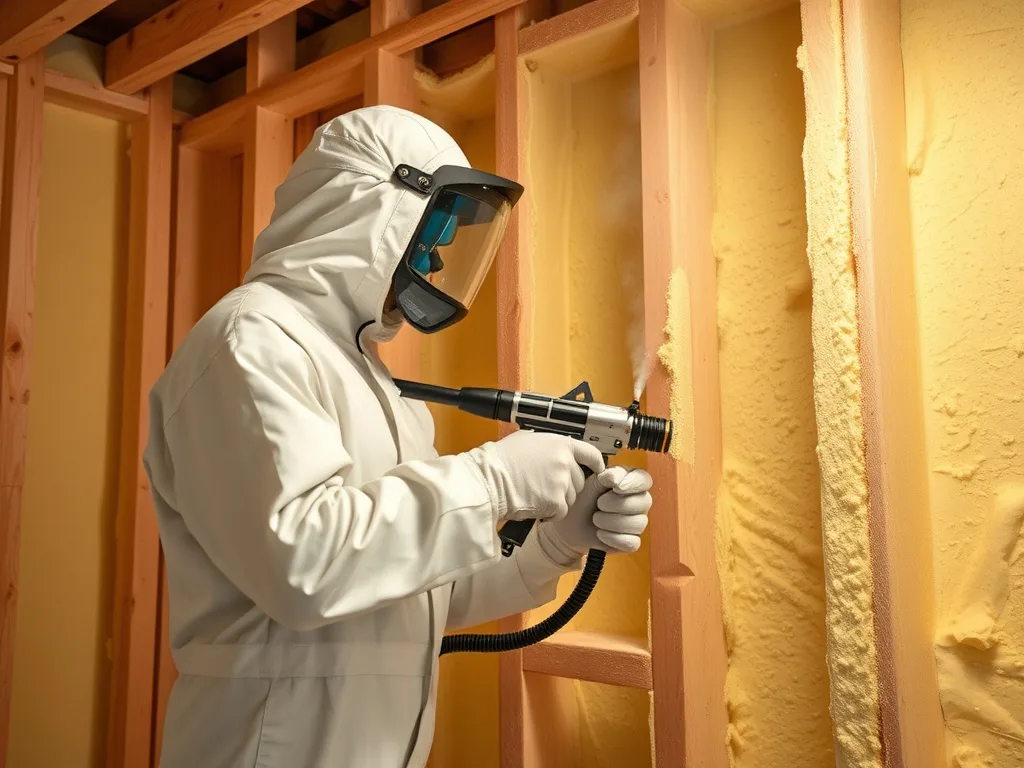
Closed-cell is applied in controlled lifts of roughly two inches per pass — spray it thicker in one go and the exothermic cure generates too much heat, which is one of several reasons this is professional-rig work rather than kit work. The crew masks and contains the area, builds thickness in passes with cure time between them, and verifies depth with gauge pins as they go. Most residential-scale closed-cell jobs finish in one to two days.
Occupants are out of the building on spray day with standard re-occupancy at 24 hours, and code items are handled as part of the scope: ignition barrier coatings over exposed foam in attics and garages, thermal barrier separation at living spaces, and vent closure per IRC R806.5 on unvented roof-deck conversions. Every job ends with a measured-depth walkthrough — you paid for inches and R-value, and we show you both before we leave.
Common Questions
Closed-Cell Spray Foam FAQs
Straight answers from the crew that does the work. More on our full FAQ page.
Have a different question? Read all 26 FAQs or see our 2026 Phoenix cost guide.
Related Services
You Might Also Need
Open-Cell Spray Foam
Budget-friendly air sealing and sound control — the workhorse for Phoenix attics and interior walls.

Commercial Spray Foam
Warehouses, metal buildings, offices — control conditioning costs at commercial scale.

Attic Insulation
Phoenix attics hit 150°F+. A sealed, foamed attic can run within 10°F of your living space.
Ready to Stop Paying to Cool the Desert?
Get a free, no-pressure spray foam quote for your Phoenix home or building. Most quotes delivered within 24 hours.