Phoenix Metro • Licensed Pros
Commercial Spray Foam Insulation in Phoenix
Warehouses, metal buildings, offices — control conditioning costs at commercial scale.
In a Phoenix warehouse, air conditioning is the number-one operating cost, and most of that money leaks straight through an under-insulated roof and bare metal walls. Spray foam attacks the problem at commercial scale: high R-value per inch, a continuous air seal across thousands of square feet, and condensation control on metal skins — all installed on a schedule that works around your crews and customers. We spray warehouses, shops, churches, self-storage, and flat roofs across the Valley.
R-6–7
Per inch, closed-cell
The workhorse spec for metal buildings and flat roofs — and it holds that rating even at 160°F deck temperatures.
20–40%
Cooling-cost reduction
Typical range after sealing a leaky commercial envelope in Zone 2B, where cooling dominates the utility bill.
15–20 yrs
Foam roof recoat cycle
A sprayed foam roof with elastomeric coating needs a recoat every 15–20 years — not a tear-off.
Who We Serve Across the Phoenix Metro
Commercial spray foam covers a much wider range of buildings than most owners realize. The common thread is a big envelope, a big cooling load, and an owner who is tired of watching the electric bill climb every June. If the building is conditioned — or you want it to be — foam is usually the fastest path to controlling the cost of keeping it that way.
We bid and install for warehouses and distribution space, machine shops and fabrication buildings, churches and assembly halls, self-storage facilities, agricultural buildings, restaurants, offices, and flex space. Each has its own spec: a climate-controlled storage facility needs tight temperature bands, a fabrication shop needs foam that shrugs off vibration and abuse, and a church sanctuary with a 30-foot ceiling needs the roof deck handled or nothing else matters.
- Warehouses and distribution — roof deck and wall foam to cut the largest cooling loads in the Valley
- Metal buildings and shops — closed-cell on the skin for R-value, rigidity, and condensation control
- Flat and low-slope roofs — sprayed foam roofing systems with elastomeric coating
- Churches, gyms, and assembly spaces — big-volume envelopes where duct losses and roof gain compound
- Self-storage and climate-controlled units — tight temperature bands with minimal mechanical tonnage
- Restaurants and offices — occupied-building installs scheduled after hours
Metal Building Insulation — Solving the Raining Ceiling
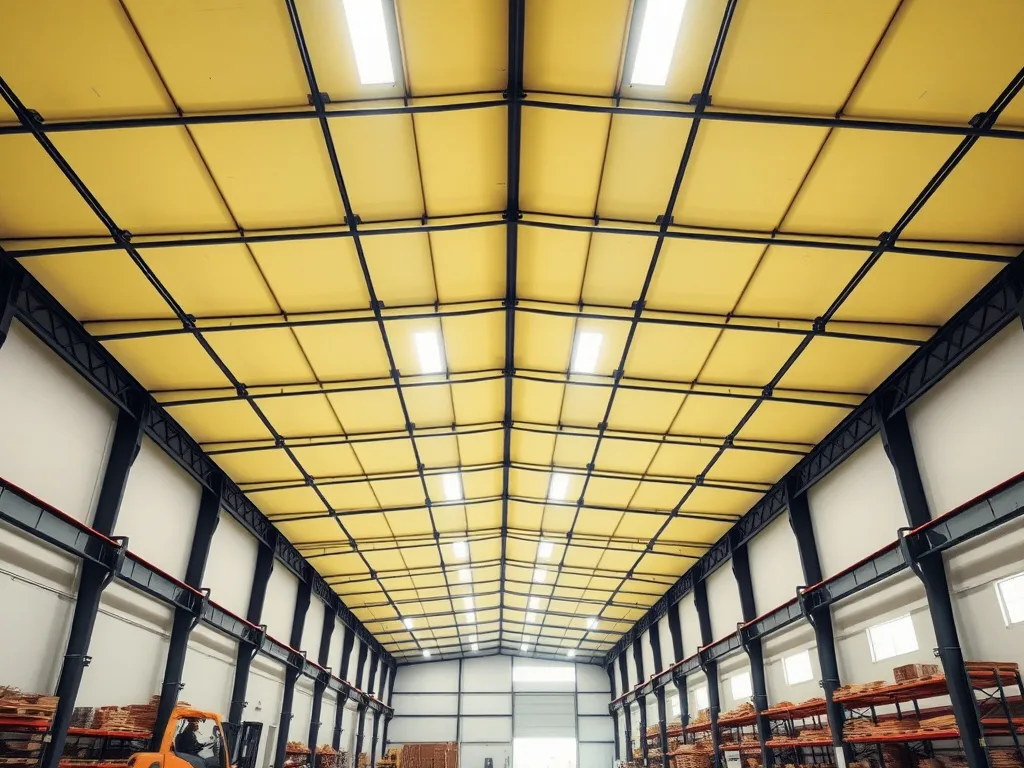
Bare metal buildings in Phoenix have two problems, and most owners only budget for one. The obvious one is heat: a steel skin in direct sun conducts heat almost instantly, and interior temperatures track the outside within minutes. The second shows up on the handful of humid mornings after a monsoon storm — condensation. When night air cools the metal below the dew point, moisture films on the underside of the roof panels and drips onto inventory, equipment, and drywall. Owners call it the raining ceiling, and vinyl-faced batt systems sagging between purlins do very little to stop it.
Closed-cell spray foam fixes both problems in a single pass. At R-6 to R-7 per inch, two to three inches on the walls and roof panels delivers real thermal performance, and because closed-cell is a vapor retarder at two inches or more, the metal surface never sees interior air — condensation has nowhere to form. The foam also bonds to the panels and stiffens them, cutting the oil-canning rattle and wind noise metal buildings are known for.
For most Phoenix metal buildings we spec closed-cell at $1.00–$1.65 per board foot installed. On a typical shop that means the building goes from unconditionable to holding setpoint with a modest package unit or mini-splits, and the condensation problem is gone permanently rather than managed.
Spray Foam Roofing for Flat and Low-Slope Roofs
Sprayed polyurethane foam roofing is the dominant flat-roof retrofit in Phoenix for a simple reason: it adds insulation and waterproofing in the same application, over the top of the existing roof, without a tear-off. Foam is applied directly to the prepared deck, self-flashes around penetrations and parapets, and is then top-coated with a reflective elastomeric coating that handles UV and reflects a large share of the solar load before it ever becomes heat.
The maintenance story is what wins owners over long-term. A foam roof is not a replace-every-15-years membrane — it is a recoat-every-15-to-20-years system. When the coating wears thin, a new coat restores the surface without touching the foam beneath it, and the cycle repeats. Buildings around the Valley are running on foam roofs that were first sprayed decades ago.
Because the foam adds R-value on top of the deck, the roof stops being the building's biggest thermal weak point. On a single-story commercial building, the roof is most of the envelope — insulating it from above changes the cooling load more than any wall measure can.
The Energy Math on a Phoenix Commercial Building
Phoenix sits in IECC Climate Zone 2B, where cooling degree days dwarf everything else. For a conditioned warehouse or shop, electricity for cooling is typically the largest single operating cost, and the two biggest drivers are roof gain and uncontrolled air leakage at the eaves, base flashing, and panel laps. Spray foam addresses both at once — R-value plus an air seal in one material — which is why sealed commercial envelopes in the Valley commonly see cooling costs drop 20–40%.
The second-order savings show up in the mechanical room. A tighter envelope means the existing rooftop units cycle instead of running flat-out through the afternoon peak, equipment life stretches, and at replacement time the load calculation frequently supports fewer tons. For businesses on demand-billed commercial rate plans, flattening the afternoon peak is worth real money on top of the raw kWh reduction.
Code and Spec: Getting Commercial Foam Right
Commercial foam work has code items that a residential-only crew will miss. The IECC commercial envelope provisions set minimum R-values by assembly, and spray foam in occupied spaces must be separated from the interior by an approved thermal barrier — typically drywall. In storage and limited-access areas, an ignition barrier or intumescent coating applied over the foam can satisfy the requirement instead. We spec the right barrier for each space in the bid, not as a change order after the inspector walks through.
Thickness verification matters at commercial scale too. Foam is priced by the board foot — one square foot at one inch thick — and our crews probe and document installed depth so you get the R-value you paid for across the whole deck, not just where the estimator stood. Bid documents state foam type, target thickness, achieved R-value, and barrier coatings line by line.
Project Logistics: Working Around a Live Business
Most commercial buildings cannot simply close for a spray project, so scheduling is part of the spec. We routinely stage jobs after hours, overnight, and on weekends, and we phase larger buildings bay by bay so operations continue in the sections we are not spraying. Occupied-building safety is non-negotiable: spray areas are isolated and ventilated, adjacent zones are protected from overspray, and re-entry times are communicated in writing before work starts.
High work is our problem, not yours. Scissor lifts and boom lifts for deck work, containment for finished spaces below, and floor and equipment masking are all included in the plan. On exterior roof work we coordinate around weather windows — foam roofing needs dry conditions and the right surface temperatures, which in Phoenix means most of the year qualifies.
- After-hours, overnight, and weekend spray windows
- Phased bay-by-bay scheduling for buildings that stay open
- Lift work, containment, and masking included in the bid
- Written re-entry times and ventilation plan before spray day
- Documented thickness probes and photo records at closeout
What Commercial Projects Cost
Commercial pricing follows the same board-foot logic as residential — open-cell at $0.45–$0.90 per board foot, closed-cell at $1.00–$1.65 — but larger projects earn volume efficiency, and foam roofing is quoted per square foot as a system including the coating. Every building is different enough that we bid from drawings or a walkthrough rather than a phone estimate, but the table below shows how typical Valley projects shake out.
| Project type | Typical spec | How it is priced |
|---|---|---|
| Metal building walls + roof, 5,000 sq ft | Closed-cell, 2–3 inches | $1.00–$1.65 per board foot |
| Warehouse roof deck, interior | Open-cell 5.5 in or closed-cell 3 in | Board-foot, volume-tiered |
| Flat roof SPF system + coating | Foam plus elastomeric topcoat | Per square foot, system price |
| Occupied office or restaurant | Assembly-specific hybrid | Per project, phased schedule |
| Foam roof recoat (existing SPF) | Elastomeric recoat only | Per square foot, every 15–20 yrs |
Bidding, GCs, and Design-Assist
We work plan-and-spec when the documents are complete, and design-assist when they are not. If your architect has already specified foam type, thickness, and barrier coatings, we bid it straight and hit the spec. If the drawings just say insulation, we will propose the assembly that makes sense for a Zone 2B envelope — usually closed-cell on metal and masonry, open-cell on framed interior assemblies — with the R-value and code documentation your plan reviewer wants to see.
General contractors get a sub who shows up when the schedule says, coordinates with the trades around us, and does not leave barrier coatings or thickness documentation for someone else to chase. Building owners going direct get the same bid clarity: board-foot math shown, code items included, and one number that does not grow after mobilization. Call 844-967-5247 with a plan set or a site address and we will take it from there.
Common Questions
Commercial Spray Foam FAQs
Straight answers from the crew that does the work. More on our full FAQ page.
Have a different question? Read all 26 FAQs or see our 2026 Phoenix cost guide.
Related Services
You Might Also Need

Closed-Cell Spray Foam
Maximum R-value per inch plus a built-in moisture barrier — ideal for metal buildings and block walls.
New Construction
Build it tight from day one — sealed envelopes, smaller HVAC, better HERS scores.

Energy Audits
Thermal imaging finds exactly where your cold air escapes — and what it's costing you.
Ready to Stop Paying to Cool the Desert?
Get a free, no-pressure spray foam quote for your Phoenix home or building. Most quotes delivered within 24 hours.